

Smart Ports Market to Hit $15.5 Billion by 2032 | AI, IoT, and Automation Adoption
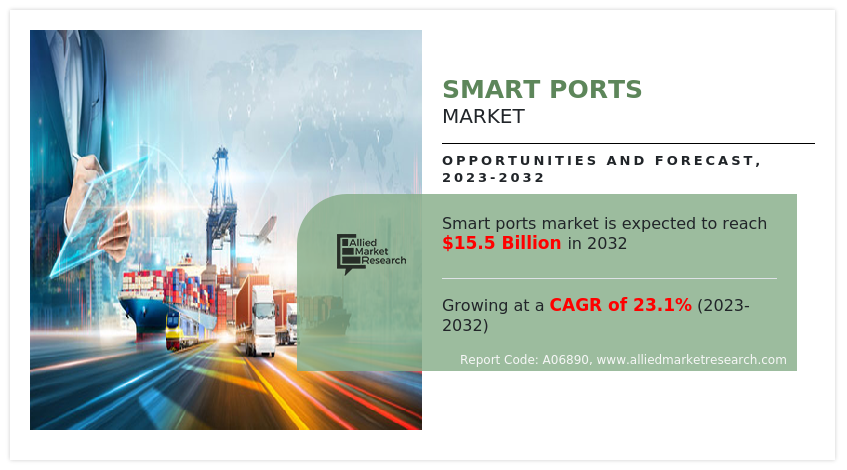
Rising trade volumes, digital transformation initiatives, and smart port technology investments are driving significant growth across the Smart Ports Market.
The Smart Ports Market is witnessing strong growth as ports adopt AI, IoT, automation, and data analytics to improve efficiency, sustainability, and cargo management.”
WILMINGTON, DE, UNITED STATES, June 11, 2026 /EINPresswire.com/ -- The Smart Ports Market is undergoing a significant transformation as ports across the world embrace digital technologies to improve operational efficiency, sustainability, cargo visibility, and supply chain resilience. According to recent industry analysis, the market was valued at $2.0 billion in 2022 and is projected to reach $15.5 billion by 2032, registering a CAGR of 23.1% during the forecast period.— Allied Market Research
Global trade continues to expand rapidly, creating unprecedented pressure on port infrastructure. Traditional port operations are increasingly being replaced by connected ecosystems powered by artificial intelligence, Internet of Things (IoT), blockchain, automation, cloud computing, and advanced analytics. These technologies enable ports to handle larger cargo volumes, reduce vessel turnaround times, optimize asset utilization, and improve decision-making through real-time insights.
Download PDF Brochure: https://www.alliedmarketresearch.com/request-sample/A06890
The growing emphasis on supply chain efficiency, environmental sustainability, and operational transparency is accelerating investments in smart port infrastructure worldwide. Governments, logistics providers, shipping companies, and port authorities are recognizing the importance of digital transformation in maintaining competitiveness in an increasingly interconnected global economy.
As maritime trade becomes more complex and cargo volumes continue to rise, smart ports are emerging as critical hubs that combine technology, connectivity, and automation to create safer, more efficient, and environmentally responsible logistics networks.
Market Overview
The Smart Ports Market represents the convergence of maritime infrastructure and advanced digital technologies. Smart ports utilize interconnected systems that collect, analyze, and process vast amounts of operational data to optimize port performance.
Unlike conventional ports, smart ports rely on intelligent technologies that provide visibility across cargo movement, vessel traffic, equipment performance, workforce management, and environmental conditions. This integrated approach enables port authorities to make data-driven decisions that improve productivity and reduce costs.
The increasing adoption of digital transformation initiatives across the maritime industry has significantly enhanced demand for smart port solutions. Rising international trade, growing containerization, and expanding e-commerce activities are further strengthening the business case for smart port investments.
Modern ports are evolving into intelligent logistics ecosystems capable of managing complex supply chains while supporting sustainability goals. As a result, the Smart Ports Market continues to attract investments from governments, technology providers, logistics operators, and infrastructure developers worldwide.
Market Dynamics
Several factors are influencing the growth trajectory of the Smart Ports Market. The primary growth driver is the increasing need to manage rising cargo volumes efficiently. Ports are under pressure to minimize congestion, reduce delays, and maximize throughput while maintaining high levels of safety and security.
Advancements in IoT technologies have made it possible to deploy connected sensors throughout port facilities, providing real-time visibility into cargo movements, equipment conditions, and operational performance. This capability significantly enhances productivity and operational planning.
Artificial intelligence and machine learning technologies are also transforming port operations by enabling predictive maintenance, automated scheduling, traffic optimization, and intelligent resource allocation.
However, the market faces several challenges. Legacy infrastructure remains a major obstacle, particularly in older ports where modernization requires substantial capital investments. Integration of new digital systems with existing infrastructure can be complex and time-consuming.
Cybersecurity concerns are another critical challenge. As ports become increasingly connected, the risk of cyberattacks targeting operational technology systems continues to rise.
Despite these challenges, the long-term outlook remains highly positive due to increasing trade volumes, technological innovation, and strong government support for digital infrastructure development.
Market Drivers
The expansion of international trade remains one of the strongest drivers of the Smart Ports Market. Global supply chains are becoming increasingly complex, requiring ports to process larger cargo volumes with greater speed and accuracy.
Another major growth driver is the adoption of automation technologies. Automated cranes, autonomous vehicles, robotic cargo handlers, and AI-driven logistics systems are helping ports improve productivity while reducing operational costs.
Environmental sustainability initiatives are also encouraging smart port adoption. Ports are implementing intelligent energy management systems, emission monitoring platforms, and electrification technologies to support decarbonization goals.
Government programs supporting digital infrastructure modernization are further accelerating market growth. Many countries have introduced funding programs and incentives aimed at promoting smart transportation and logistics networks.
The increasing demand for supply chain visibility and operational transparency is also contributing to the adoption of smart port solutions across both developed and emerging economies.
Market Restraints
Despite strong growth prospects, the Smart Ports Market faces several restraints. High implementation costs remain a significant barrier, particularly for smaller ports with limited financial resources.
Many ports operate on legacy systems that were not designed to support advanced digital technologies. Upgrading these facilities often requires extensive infrastructure investments and lengthy implementation timelines.
Cybersecurity risks represent another challenge. As ports rely more heavily on connected systems and data-driven operations, protecting critical infrastructure from cyber threats becomes increasingly important.
Workforce adaptation is also a concern. Successful smart port deployment requires skilled personnel capable of managing advanced technologies and interpreting complex data insights.
Regulatory uncertainties related to data sharing, digital standards, and cross-border logistics integration can further slow adoption in some regions.
Market Opportunities
The Smart Ports Market presents substantial opportunities for technology providers, infrastructure developers, logistics companies, and investors.
Emerging technologies such as digital twins, edge computing, autonomous vessels, blockchain-based documentation systems, and advanced analytics platforms are creating new growth avenues.
The increasing focus on green port initiatives offers opportunities for smart energy management, renewable energy integration, and emission reduction technologies.
Collaborations between shipping companies, logistics providers, and technology vendors are driving innovation across the maritime ecosystem.
The rise of smart cities is also creating opportunities for greater integration between ports and urban infrastructure, enabling more efficient transportation networks and logistics corridors.
As governments continue investing in national infrastructure modernization programs, smart ports are expected to play a central role in future economic development strategies.
What is a Smart Port?
One of the most searched topics within the industry is: What is a Smart Port?
A smart port is a technologically advanced port facility that utilizes digital technologies, automation, artificial intelligence, IoT devices, and data analytics to optimize maritime and logistics operations.
Unlike conventional ports, smart ports continuously collect and analyze data from vessels, cargo, equipment, vehicles, and infrastructure. This information enables real-time decision-making, predictive maintenance, automated operations, and enhanced visibility across the supply chain.
Smart ports help reduce operational costs, improve cargo handling efficiency, enhance security, and support sustainability objectives. They also provide better customer experiences by enabling faster cargo processing and improved communication among stakeholders.
As global trade becomes increasingly digitized, smart ports are expected to become the standard model for future maritime operations.
Smart Ports Market
The Smart Ports Market continues to expand as organizations prioritize digital transformation and supply chain resilience.
Port operators are investing heavily in intelligent technologies to address operational inefficiencies and growing cargo demand. Digital transformation programs are becoming essential for maintaining competitiveness in international trade.
The increasing deployment of AI-driven systems, automated equipment, and real-time monitoring platforms is accelerating market growth across all major regions.
Furthermore, rising investments in infrastructure modernization are creating a favorable environment for long-term market expansion.
Procure This Report (410 Pages PDF with Insights, Charts, Tables, and Figures): https://www.alliedmarketresearch.com/smart-ports-market/purchase-options
Smart Port Market and Technology Evolution
The Smart Port Market is benefiting from rapid technological innovation. Ports are increasingly integrating AI, blockchain, cloud computing, digital twins, and predictive analytics into daily operations.
These technologies improve resource allocation, optimize vessel scheduling, enhance cargo visibility, and support predictive maintenance programs.
The evolution of smart port technology is transforming ports from traditional transportation hubs into highly connected digital ecosystems capable of supporting next-generation logistics operations.
Port Automation Solutions Market
The growth of the Port Automation Solutions Market is closely linked to smart port adoption.
Automation technologies are being deployed across cargo handling, container management, vehicle coordination, and warehouse operations. Automated cranes and robotic systems significantly reduce processing times while improving operational accuracy.
AI-powered automation enables ports to operate continuously with minimal human intervention, increasing efficiency and reducing labor-intensive activities.
As labor shortages and operational complexities increase, demand for automation solutions is expected to rise significantly.
Port Equipment Market
The Port Equipment Market plays a vital role in supporting smart port development.
Modern ports require advanced equipment capable of integrating with digital platforms and automated systems. Intelligent cranes, autonomous vehicles, sensor-enabled machinery, and predictive maintenance technologies are becoming standard features in leading ports.
Equipment manufacturers are increasingly focusing on connectivity, energy efficiency, and automation capabilities to meet evolving industry requirements.
The modernization of port equipment is expected to remain a major investment priority throughout the forecast period.
Intelligent Port Development and Smart Port Technology
The concept of an Intelligent Port extends beyond automation by incorporating advanced analytics, machine learning, and real-time decision support systems.
Smart Port Technology enables ports to anticipate operational challenges, optimize workflows, and improve customer service. Real-time monitoring systems provide actionable insights that support faster and more informed decision-making.
Digital twins are becoming increasingly popular within intelligent port environments, allowing operators to simulate operational scenarios and identify optimization opportunities before implementing changes.
The integration of these technologies is expected to define the future of global maritime infrastructure.
Global Trade is Expanding, Leading to Increased Cargo Volumes. How Should a Port Respond to This Trend to Remain Competitive?
As global trade expands and cargo volumes increase, ports must adopt a proactive strategy to remain competitive.
The most effective response involves investing in automation, digitalization, and smart infrastructure. Ports that continue relying on traditional operating models risk congestion, inefficiency, and declining competitiveness.
Implementation of AI-powered logistics systems, automated cargo handling technologies, predictive analytics, and integrated transportation networks can help ports accommodate growing demand while maintaining service quality.
Ports must also focus on sustainability initiatives, cybersecurity preparedness, workforce development, and stakeholder collaboration to remain competitive in a rapidly evolving logistics environment.
Europe Smart Ports Market
The Europe Smart Ports Market is experiencing steady growth due to strong government support for digitalization and sustainability.
Major European ports are investing in AI, IoT, blockchain, and automation technologies to improve efficiency and reduce environmental impacts. The region’s commitment to carbon neutrality and green transportation is encouraging adoption of smart port solutions.
European ports are also leading efforts to integrate renewable energy systems and digital logistics platforms into maritime operations.
Australia Smart Ports Market
The Australia Smart Ports Market is expanding as the country modernizes its maritime infrastructure to support international trade growth.
Australian ports are investing in automation technologies, digital monitoring systems, and predictive maintenance platforms. These investments aim to improve cargo handling efficiency while enhancing supply chain visibility.
The country’s strong focus on resource exports and international shipping creates substantial opportunities for smart port technology deployment.
Smart Ports in the World
Several of the world’s leading ports have become benchmarks for digital transformation.
Ports in Singapore, China, South Korea, Japan, the Netherlands, and Australia have successfully implemented smart technologies that enhance operational performance and sustainability.
These smart ports in the world demonstrate how technology can improve efficiency, reduce costs, and strengthen global supply chains.
Their success is encouraging other port authorities to accelerate digital transformation initiatives and adopt similar operational models.
Smart Ports Research and Industry Innovation
Smart Ports Research continues to drive innovation across the maritime sector.
Universities, technology providers, government agencies, and industry organizations are collaborating on research initiatives focused on automation, AI, cybersecurity, sustainability, and digital logistics.
Research efforts are helping identify new opportunities for improving operational efficiency while supporting environmental objectives.
Continued innovation is expected to accelerate the adoption of next-generation smart port technologies worldwide.
Port Services Market and Related Industries
The broader Port Services Market is also benefiting from smart port development.
Digital technologies improve vessel scheduling, cargo tracking, customs processing, and logistics coordination. These improvements enhance service quality while reducing operational bottlenecks.
Related sectors such as the Port Adapters Market are also experiencing growth as ports upgrade infrastructure to support modern digital systems and connectivity requirements.
The increasing integration of smart technologies across the maritime ecosystem is creating value throughout the supply chain.
Regional Analysis
Asia-Pacific dominates the Smart Ports Market and is expected to maintain its leadership position throughout the forecast period. Rapid industrialization, growing trade volumes, and strong government support for digital transformation contribute to regional growth.
China, Singapore, Japan, South Korea, and Australia remain among the most technologically advanced maritime markets globally.
North America continues to invest heavily in smart logistics infrastructure and automation technologies, while Europe focuses on sustainability and digital innovation.
Emerging economies in Latin America, the Middle East, and Africa are also increasing investments in smart port infrastructure to strengthen international trade competitiveness.
Competitive Landscape
The Smart Ports Market features a competitive environment characterized by innovation, strategic partnerships, and technology investments.
Leading companies include Royal Dutch Shell, Cisco Systems, KONGSBERG, ABB Ltd., Huawei Technologies, Kaleris, IBM Corporation, Trelleborg, Intel Corporation, and Abu Dhabi Ports.
Future Outlook
The future of the Smart Ports Market remains exceptionally promising. Growing cargo volumes, increasing global trade activity, rising sustainability requirements, and rapid advances in digital technologies will continue driving market growth.
IoT, artificial intelligence, blockchain, digital twins, autonomous vehicles, and predictive analytics are expected to become foundational components of next-generation port operations.
Get a Customized Research Report: https://www.alliedmarketresearch.com/request-for-customization/A06890
Conclusion
The Smart Ports Market is entering a period of rapid expansion, supported by technological innovation, rising global trade volumes, and increasing demand for operational efficiency. From AI-powered automation and IoT-enabled monitoring systems to intelligent cargo handling and predictive analytics, smart port technologies are transforming the way ports operate and compete in the global economy.
While challenges such as infrastructure modernization costs, cybersecurity concerns, and integration complexities remain, the long-term opportunities significantly outweigh the risks. Governments, port authorities, logistics providers, and technology companies are actively investing in digital transformation initiatives to create resilient, sustainable, and highly efficient maritime ecosystems.
Trending Reports in Energy and Power Industry:
Smart Ports Market
https://www.alliedmarketresearch.com/smart-ports-market-A06890
LNG Carrier Market
https://www.alliedmarketresearch.com/lng-carrier-market-A09307
LNG Engine Market
https://www.alliedmarketresearch.com/lng-engine-market-A325619
Bunker Fuel Market
https://www.alliedmarketresearch.com/bunker-fuel-market
Marine Bunker Oil Market
https://www.alliedmarketresearch.com/marine-bunker-oil-market
Singapore Bunker Fuel Market
https://www.alliedmarketresearch.com/singapore-bunker-fuel-market-A14491
LNG Bunkering Market
https://www.alliedmarketresearch.com/lng-bunkering-market
Power Ship Market
https://www.alliedmarketresearch.com/power-ship-market-A06801
About Us
Allied Market Research (AMR) is a full-service market research and business-consulting wing of Allied Analytics LLP based in Portland, Oregon. Allied Market Research provides global enterprises as well as medium and small businesses with unmatched quality of "Market Research Reports" and "Business Intelligence Solutions." AMR has a targeted view to provide business insights and consulting to assist its clients to make strategic business decisions and achieve sustainable growth in their respective market domain.
David Correa
Allied Market Research
+ + + + + + + + + + + + + +1 800-792-5285
email us here
Visit us on social media:
LinkedIn
Facebook
YouTube
X
Legal Disclaimer:
EIN Presswire provides this news content "as is" without warranty of any kind. We do not accept any responsibility or liability for the accuracy, content, images, videos, licenses, completeness, legality, or reliability of the information contained in this article. If you have any complaints or copyright issues related to this article, kindly contact the author above.
